Enzo’s Life Ends and His Soul Departs
The Art of Racing in the RainEnzo’s death is presented not as a single moment of bodily failure but as a passage from age and pain into imagined freedom. In the apartment, he can no longer eat, his legs buckle, and his heartbeat weakens beneath Denny’s hand. Yet his consciousness turns toward an open field where he can run again. The ending gives physical decline its full weight while allowing Enzo to understand death as release rather than extinction.
The failing body and the will to die
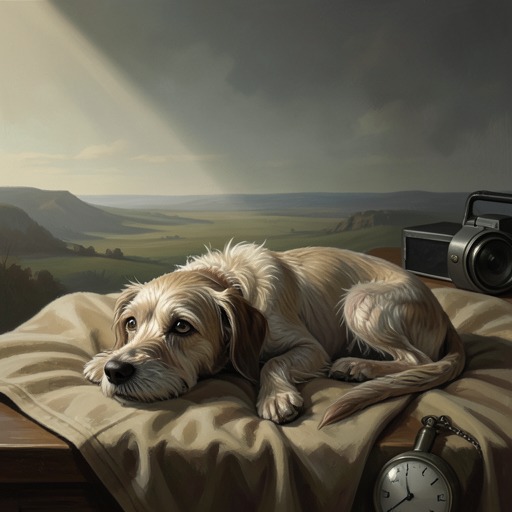
At dawn, Enzo reflects that life has seemed both long and short. People speak of the will to live, he observes, but rarely of the will to die, because death appears dark and frightening to them. He does not share that fear: for him, death is not the end. This conviction is tested by the body he inhabits. His hips have frozen, his legs burn, and standing requires all the strength he can summon; still, he hobbles from the bedroom toward Denny in the kitchen.
The domestic scene makes his decline unmistakable. Denny has returned to cooking breakfast, something he used to do when Eve and Zoë were still part of the household. During their long absence, he had eaten cereal instead. Enzo tries to wag his tail when Denny calls to him, but the effort makes him urinate on the floor. Denny cleans the mess without reproach and tears off a piece of pancake for him. Enzo takes it into his mouth but cannot chew or taste it; the food lies on his tongue and falls to the floor. Denny appears to notice but says nothing, continuing to flip pancakes. Care persists in the small acts of the kitchen even as Enzo can no longer participate in its ordinary pleasures.
Enzo does not want his condition to make Denny suffer by forcing him to choose a visit to the veterinarian. He distinguishes that feared decision from assisted suicide, which he imagines as an elder’s deliberate act: a machine, a large red button, and responsibility for one’s own death. His speculation about inventing such a device for dogs expresses a wish to spare Denny the burden of causing his death. The story does not show Enzo using a machine or being taken to a veterinarian; instead, it makes his decline and his readiness to leave the center of the final scene.
Collapse beside Denny
Enzo’s thoughts about aging extend beyond his own immediate pain. He calls growing old a process of limitation and reduction, then imagines a future child who might refuse to age and remain healthy until choosing to die. This is his conjecture, not a change in the events around him, but it reveals how closely he associates bodily decay with the loss of agency. His own wish is not simply to prolong life at any cost: he wants to leave when his body can no longer support the life he recognizes as his.
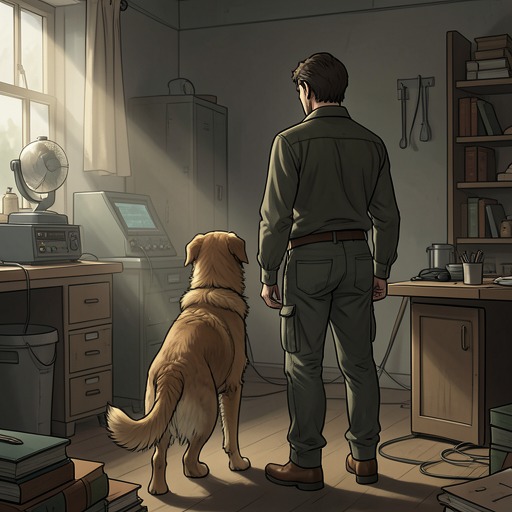
When Denny sees him, he reaches down by habit and scratches the crease of Enzo’s ears. Their long companionship survives in this familiar touch, which Enzo experiences as the touch of a man. Then Enzo’s legs buckle and he falls. Denny crouches over him, turns off the burner beneath the frying pan, and puts a hand over his heart. The sequence shifts abruptly from breakfast to a vigil: the food is left behind as Denny attends to the faint beating beneath his palm.
The scene does not give Denny a spoken explanation of what is happening. Enzo’s inner account instead holds together two apparently opposed truths: he believes himself ready, and he knows Denny will be devastated by his loss. He would rather remain in the apartment with Denny and Zoë, watching people on the street below greet one another. His reluctance makes departure an act of attachment as well as release. The bond that makes him want to stay is also what makes him concerned for Denny’s grief.
The future Enzo hopes to witness
As Denny cradles his head, Enzo imagines the life that lies ahead for him and Zoë. He expects Zoë to return to her father that afternoon and pictures them moving together to Maranello, living in a small-town apartment and driving a Fiat. He imagines Denny’s ability being recognized at Ferrari: first as a test driver, then as a Formula One competitor, and ultimately as a champion. These are Enzo’s forward-looking hopes in the moment of his death, not events he lives to witness. Their significance lies in the future he entrusts to Denny after his own presence is gone.
That vision is inseparable from Enzo’s understanding of racing. He has learned that racing in the rain requires balance, anticipation, and patience, but also a way of experiencing the self as continuous with the car, the track, and the weather. He revises his earlier judgment that racing drivers are selfish: in his account, a champion must give up the idea of existing as a separate entity and depend upon the team, car, shoes, and tires. The reflection gives his departure a particular shape. He has spent his life imagining unity through racing; at the threshold of death, he describes selfhood not as something isolated but as part of a larger world.
Enzo also recalls a documentary about dogs in Mongolia, which said that a dog ready to leave doghood behind would be reborn as a man. His certainty that he is ready rests on this belief in another form of life, while his admission that he may not see Denny and Zoë reunited gives the scene its limit: he must leave without witnessing the future he longs for. The story holds belief and uncertainty together. Enzo cannot know that future from experience, but he chooses to trust it.
Departure into the field
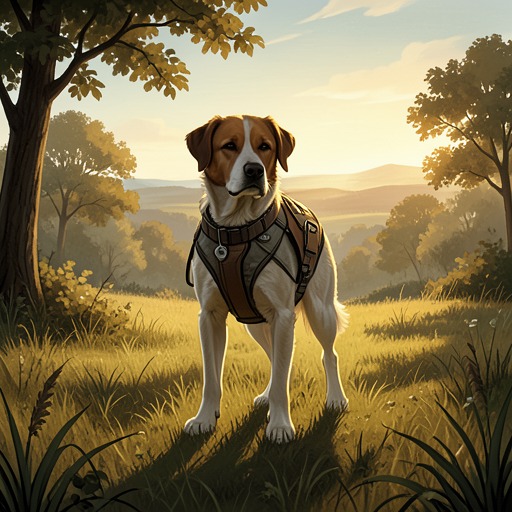
Denny’s gentle reassurance accompanies the transition. Enzo remembers the documentary’s account that a dog’s soul is released into the world after death, free to run through fields and encounter the earth, wind, rivers, rain, and sun until ready to be reborn. The field is not presented as a destination Denny can see; it is the world as Enzo experiences his release. The contrast is sharp: in the apartment his legs burn and fail, while in the field he feels the cool air and sun on his coat and senses himself as present.
Enzo gathers strength and runs, feeling timeless rather than old. He does not look back, though he knows Denny is there and feels his gaze. He barks twice so Denny will hear and remember him, then urges one more lap. The repeated racing image transforms his final movement into both a farewell and a continuation: the body that could not chew a pancake or remain standing becomes, in Enzo’s departing consciousness, capable of speed again.
After this passage, the narrative moves to Imola, Italy, and shows Denny alone on the wet grass at Tamburello Corner after winning the season championship. His Ferrari-red racing suit is covered in sponsor patches; elsewhere, people celebrate, while other drivers marvel at what he has endured and achieved. The scene does not establish that Enzo witnesses Denny’s victory. Instead, its placement follows Enzo’s imagined future with an image of Denny as champion, allowing the hoped-for life to resonate beyond the moment Enzo leaves. His last racing cry is therefore both personal and forward-looking: a message to Denny to keep going, and an expression of the freedom Enzo finds as his life ends.